Why employ it in the classroom?
There is an abundance of benefits to integrating Virtual Reality (VR) experiences in the classroom such as tapping into critical, creative and higher order thinking and developing collaboration skills (particularly through virtual/online environments (Yildirim, Sahin-Topalcengiz, Arikan, & Timur, 2020).
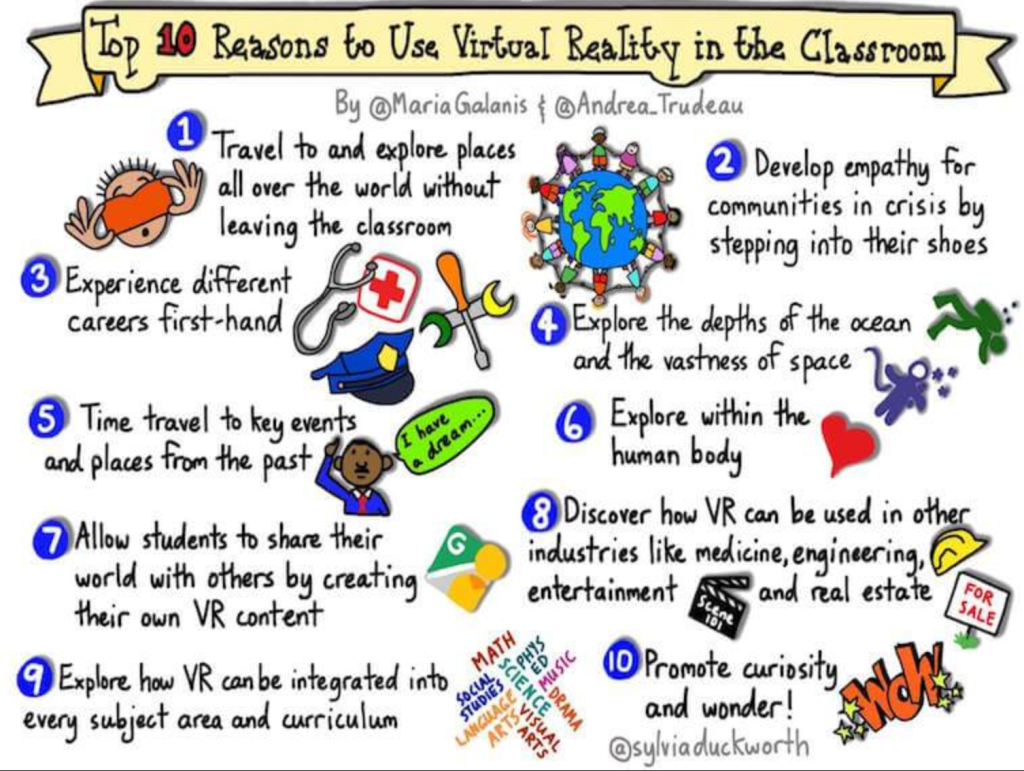
There are various opportunities to implement VR in integrated units and work as it can be used in a variety of areas of learning. English, History, Science, and it provides an authentic context to explore the interrelation of STEAM concepts and skills (e.g. robotics construction, engineering projects out-of-country, marine biologist applications etc).
VR can increase the relevance and authenticity of learning through showcasing 3D models and immersive experiences. Rather than looking at an image of the human heart, you can travel inside it or observe a surgeon’s perspective of it. Observe the effects of emotive writing and poetry techniques in speeches by watching Martin Luther King’s “I Have A Dream Speech”.
A significant affordance of VR experiences is that they provide freedom to explore systems/places/concepts from the safety of the classroom. For an upper high school class learning about the Holocaust – taking a virtual excursion to Auschwitz mitigates travel concerns and limitations whilst still enabling the emotive intake of being present in such an environment. Furthermore, the experience can be paused and revisited permitting breaks from the emotional burdens where feelings and impacts can be discussed and worked through as they arise.
VR systems allow students to obtain immersive experiences where this may not normally be possible. Designing a to-scale bedroom looking at surface area and volume, or swimming with a pod of dolphins exploring migration patterns, looking at and manipulating molecules and observing the breakdown of a star are some curriculum connections that can be delivered through VR environments.

There are many apparent and legitimate connections to secondary curriculum however some further exploration for primary content is needed as educational VR content is often too complex for younger years.
This brings about the idea of students as creators of VR experiences. Framing the use of this emerging technology in this way mitigates the need to justify content connection to curriculum. Students can design virtual rooms, stories, environments and more to support presentations, learning and connections to map understanding of content and concepts. In this way, creativity can be harnessed.
“The immersive nature of virtual reality brings depth to educational content by engaging the senses and allowing exploration to a degree that would be difficult to duplicate within the confines of a classroom, making it an ideal catalyst for curiosity and true learning.”
TeachThought Staff, Technology, the Future of Learning https://www.teachthought.com/technology/10-reasons-use-virtual-reality-classroom/#:~:text=The%20immersive%20nature%20of%20virtual,for%20curiosity%20and%20true%20learning.
References
Takala, T. M., Malmi, L., Pugliese, R., & Takala, T. (2016). Empowering Students to Create Better Virtual Reality Applications: A Longitudinal Study of a VR Capstone Course. Informatics in Education, 15(2), 287-317. DOI: 10.15388/infedu.2016.15. Available from: https://search-proquest-com.simsrad.net.ocs.mq.edu.au/docview/1862786298?rfr_id=info%3Axri%2Fsid%3Aprimo
Yildirim, B., Sahin-Topalcengiz, E., Arikan, G., & Timur, S. (2020). Using Virtual Reality in the Classroom: Reflection of STEM Teachers on the Use of Teaching and Learning Tools. Journal of Education in Science, Environment and Health, 6(3), 231-245. DOI:10.21891/jeseh.711779. Available from: https://jeseh.net/index.php/jeseh/article/view/263/125
 Sophie's Blog