incorporation of online and offline CT tasks in primary classrooms
My recent exploration and learning on computational thinking (CT) has helped me realise that it is much more accessible than originally thought. Computational thinking involves understanding human behaviour, problem solving and generating systems through conceptualising and using elements of computer science. It is for everyone, everywhere (Kong, Chiu & Lai, 2018; Zhong, Wang, Chen & Li, 2016); computers and technology are not required.
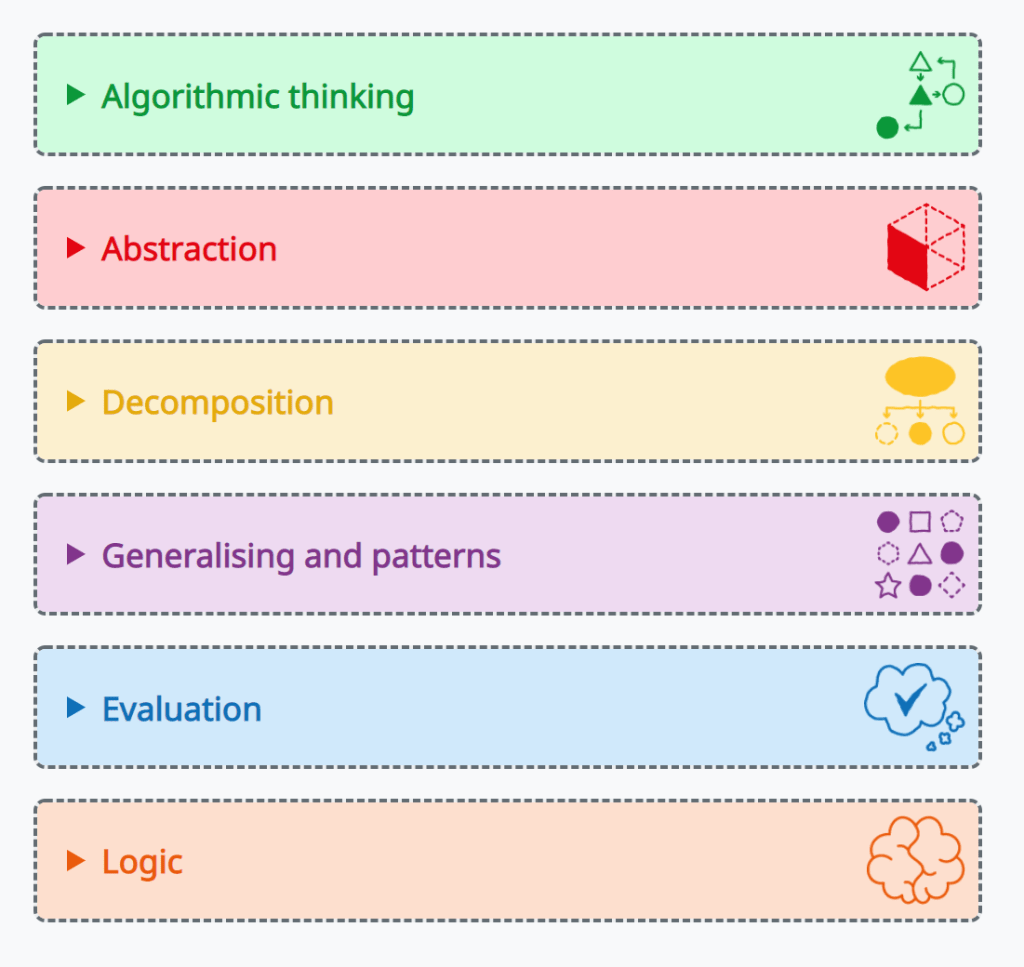
Importance of computational thinking is further highlighted by its inclusion in the Australian National Curriculum. It appears through capabilities such as implementing digital systems, organising data, breaking down problems and generating/using algorithms. It is an important element in developing good pattern recognition, generalisation, and abstraction (which has implications in most, if not all learning areas).
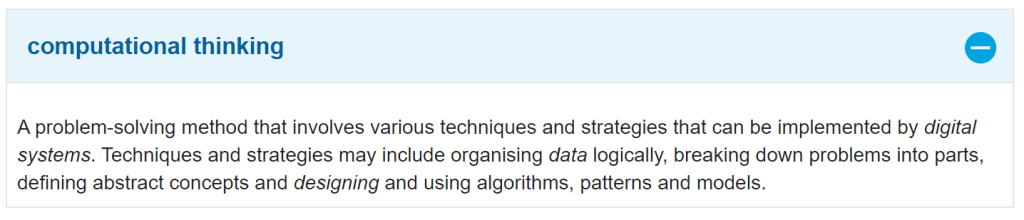
Computational thinking in a primary context is best done through a blended approach with opportunities for plugged (on digital tech) and unplugged exploration of principles (Del Olmo-Munoz, Cozar-Gutierrez & Gonzalez-Calero, 2020). Giving students connection to concreate materials before moving to virtual environments provides students assistance in generalising and abstracting CT ideas and processes (Freina, Bottino & Ferlino, 2019). CS Unplugged https://csunplugged.org/en/ has a range of resources and lesson plans in this area which are a great starting point for incorporating offline computational thinking.

Scratch (and other similar visual block programming tools) are cited as being effective in the development of CT skills and understanding (Kong, Chiu & Lai, 2018; Freina, Bottino & Ferlino, 2019). The draggable, set blocks are a good structure for experiencing problem solving and creativity through CT challenges and design as they eliminate the sometimes strenuous aspect of navigating and writing code (Freina, Bottino & Ferlino, 2019; Kong, Chiu & Lai, 2018; Zhong, Wang, Chen & Li, 2016). This semi-open to open field allows for students of all ages to approach online CT as necessary scaffolding and also freedom exists in the space (Zhong, Wang, Chen & Li, 2016; Kong, Chiu & Lai, 2018; Freina, Bottino & Ferlino, 2019; Del Olmo-Munoz, Cozar-Gutierrez & Gonzalez-Calero, 2020; Promraska, Sangaroon & Inprasitha, 2014).
In order for successful implementation of CT in a primary context, tasks should be authentic, meaningful, a blend of plugged and unplugged activites, scaffolded to support increasing autonomy, and place students at the centre of learning, empowering them to be proactive creators and sharers of knowledge (Zhong, Wang, Chen & Li, 2016; Kong, Chiu & Lai, 2018; Freina, Bottino & Ferlino, 2019; Del Olmo-Munoz, Cozar-Gutierrez & Gonzalez-Calero, 2020; Kong & Wang, 2020; Promraska, Sangaroon & Inprasitha, 2014).
References
Del Olmo-Munoz, J., Cozar-Gutierrez, R. & Gonzalez-Calero. J. A. (2020). Computational thinking through unplugged activities in early years of Primary Education. Computers & Education, 150, 2-19. https://doi.org/10.1016/j.compedu.2020.103832
Freina, L., Bottino, R. & Ferlino, L. (2019). Fostering Computational Thinking skills in the Last Years of Primary School. International Journal of Serious Games, 6(3), 101-115. http://dx.doi.org/10.17083/ijsg.v6i3.304
Kong, S. C. & Wang, Y. Q. (2020). Formation of computational identity through computational thinking perspectives development in programming learning: A mediation analysis among primary school students. Computers in Human Behaviour, 106, 1-12. https://doi.org/10.1016/j.chb.2019.106230
Kong, S. C., Chiu, M. M. & Lai, M. (2018). A study of primary school students’ interest, collaboration attitude, and programming empowerment in computational thinking education. Computers & Education, 127, 178-189. https://doi.org/10.1016/j.compedu.2018.08.026
Promraksa, S., Sangaroon, K. & Inprasitha, M. (2014). Characteristics of Computational Thinking about the Estimation of the Students in Mathematics Classroom Applying Lesson Study and Open Approach. Journal of Education and Learning, 3(3), 56- 66. http://dx.doi.org/10.5539/jel.v3n3p56
Zhong, B., Wang, Q., Chen, J. & Li, Y. (2016). An Exploration of Three-Dimensional Integrated Assessment for Computational Thinking. Journal of Educational Computing Research, 53(4), 562-590. DOI: 10.1177/0735633115608444 Available at: https://journals-sagepub-com.simsrad.net.ocs.mq.edu.au/doi/pdf/10.1177/0735633115608444
 Sophie's Blog
2 replies on “Computational Thinking”
Hi Sophie
The links made between computational thinking and the curriculum were good. I enjoyed reading about integration of a blended model, transitioning from concrete materials to more digital technologies. The research is relatable, as I am currently teaching with a year 1 class where many of the students require these concrete materials. I believe that integration of computational thinking should be through blended lessons sequences and learning experiences. Well done!
LikeLiked by 1 person
Hi Ben, thanks so much for your comment! I think it’s very easy to forget how much the younger years require the physical manipulation of concepts and objects. Good to get into the practice of considering these things before we get into the classroom. 🙂
LikeLike